The pipeline
From "Jambu, move forward" to wheels turning.
Every part of Jambu's pipeline runs locally, on the robot itself. There's no cloud service in the loop — which means it keeps working without Wi-Fi, and nothing you say is sent anywhere.
- 01
Listen
A 4-microphone array with onboard beamforming and noise suppression picks up speech and separates it from motor noise and room echo.
- 02
Detect speech
Voice-activity detection decides when someone is actually talking, so Jambu isn't transcribing silence or background chatter.
- 03
Transcribe — fully offline
A local speech-recognition model turns audio into text on-device. No audio ever leaves the robot, and it works with no internet connection.
- 04
Understand intent
The transcript is parsed for an action ('move', 'stop', 'turn') and a direction, matching natural phrasing, not just fixed command words.
- 05
Plan the motion
A motion planner turns the intent into concrete timing, direction, and speed for each wheel.
- 06
Drive
The plan is sent to the motor driver board, which powers the wheel motors directly — turning a spoken sentence into physical movement.
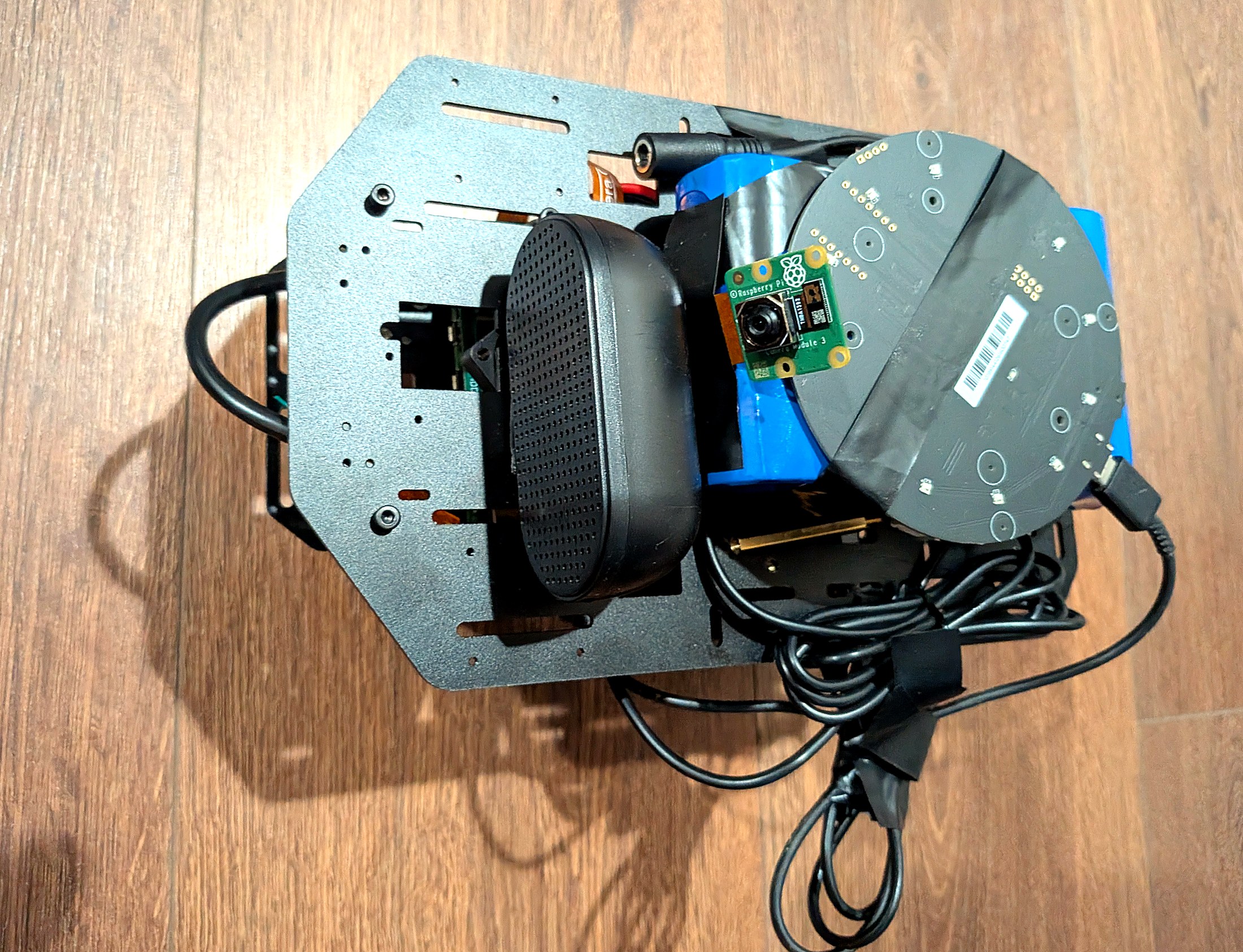
The hardware
What's actually inside.
- Raspberry Pi 5 as the brain
- 4-mic USB array with beamforming and echo cancellation
- Motor driver HAT controlling two geared drive motors
- 2WD chassis with caster wheels for balance
- 12V battery pack, fused, powering the drive system independently from the Pi